Fin Finder

Saturday, March 28, 2009

my surfboard

Wisz
  • Height: 6'3
  • Width: 11.25, 19, 14
  • Girth: 2 and 3/8ths
  • Rounded Pin
Eric Zucker
  1. one: Height: 6'1; Width: 18.75; Girth. 2 and 3/8ths
  2. shape: squash; size: 6'2; nose 11.5; tail 14; width 18.75; thickness 2.25; pinched rails; 4 oz
Eric Zucker
  • Square tail
  • Height: 6'3
  • Width: 18.5
  • Girth: 2 and 3/8ths

Monday, September 1, 2008

Custom Surfboards California

Rich Wisz
Cordell Surfboards
Wave Tools
Dano Surfboards
Ambrose surfboards
Proctor: http://www.proctorsurf.com/2002/IndexFlashCenter.html
  • Lost surfboards: The Lost Surfboard factory makes and ships thousands of boards a year throughout the USA as well as Japan. Lost surfboards are also made in Australia, New Zealand, Peru, Europe, Brazil and South Africa under strict supervision from the U.S. Matt Biolos visits all these countries yearly to shape for the locals, surf and work with internationally acclaimed shapers such as Greg Webber and Rod Dahlberg. Rick Hazard is the Sales and Production Manager. Matt Biolos and Mike Reola still fully own and operate Lost surfboards. After more than thriteen years of shaping mostly by hand, Matt now designs most our models in a "SURF CAD" Program. Most boards are ruff cut by our in house milling machine and are then fine sanded by Matt ( Team and Custom Orders ) and our impressive list of shapers such as Rick Rock, Jeff Widener, Brian Bulkley, Steve Kessler, and Darryl Butsko. Matt's been known to break shaped surfboard blanks in half, rather than send an inferior product to get fiberglassed. The demand for Lost surfboards is much higher than we can supply. - http://www.youtube.com/watch?v=iGl-1SgBVYA

http://ambrosesurfboards.com/
http://www.pureglass.com/services/inHouseShapers.htm

Sunday, June 22, 2008

surfboard features

Rocker

  • Entry rocker - Less rocker is faster and stiffer while more rocker equals looser and less speed. Basically, an inverse relationship between speed and looseness.
  • Exit rocker - a steep exit rocker or more kick, allows for a quick transition to the tail from front foot - http://cisurfboards.com/sb_kboard.asp . A straighter tail rocker increases drive.
Thickness

For a heavier guy or a heavy footed guy who bears down on waves, want thicker. I personally prefer a slightly thicker board.

Width

More dictated by the type of wave. For instance, a small wave, get a wide board like a fish. Narrower boards gain speed better in hollow waves than a thick board, at a certain point.

Length

More to do with wave size. Smaller the waves, shorter the board and thicker the rail. The bigger the waves, the longer the board and the

Concave

http://www.rusty.com/index.cfm?page=2&shaping=1


http://www.surfline.com/community/whoknows/whoknows.cfm?id=1006

Nick Carroll


All bottom designs are attempts to modify or control the water flow unde to the benefit of the rider. The water's hitting the bottom at a variety of angles and under various pressures, and it's constantly changing those angles and pressures -- but generally, it moves from somewhere near the front half of the board, through part or all of the bottom contour, and out somewhere near the back half, even directly off the board's tail.

The basis of all bottom design is the rocker line or bottom curve. This is the curve you'll see from nose to tail of your board when you hold it on its side. The three fundamental options listed below, are options to alter some part of the rocker, or basic curve.

  1. Vees - Wherever it's placed, a vee tends to create more rocker along the stringer than along the rail line. This helps to break up the water flow, guiding it out at angles away from the stringer and toward the rails. In the veed area, the board becomes easier to roll from rail to rail and to adjust turns. However, the raised stringer line causes an increase in drag, and the easy water release reduces water pressure and the resulting drive.
  2. Concaves - tend to reduce rocker along the stringer line, while maintaining it along the rail line. This contains the water flow under the board, pressuring it along the concave curve under the rail and back toward the tail and increasing lift and drive. The board becomes highly responsive to pressure and accelerates quickly from almost any point on the wave. However, the inflexible water release and fixed rail curve can make rail turns "sticky" and difficult to adjust. A heavy single concave through the tail makes the board alive in the pocket. A heavier concave
    through the fins adds more responsiveness.
    1. Single: Chest-to-double overhead+ conditions. This is a single channel in the bottom of your board running from the nose through into the tail, resembling a faint “dug-out” appearance. Here the flow of water is not refracted and is collected from the nose into this channel and runs uninterrupted through the fins. Single concave is designed for fast, large waves where you can expect spending more time in the barrel than hitting the lip.
    2. Double: Ankle-to-overhead conditions. Instead of having a channel dug out of the nose area, the bottom of your board stays relatively flat to about three-quarters of the way down then develops a “hump” that splits the water off into your two side fins. This is a great board for smaller waves because the flat front portion of the bottom of your board provides glide and speed-boosting planeing, then the double-concave gets your maneuvers going.
  3. Channels- are designed to achieve both concave and vee effects and in the hands of a master shaper are surely one of, if not the, fastest and most purely functional designs in surfboard history. In the hands of a skilled rider, channels produce extraordinary length through rail turns and provide wave "feedback" unlike any other board. But they're difficult to manufacture, unpredictable in choppy surf and perhaps best suited to expert riders and/or flawless surf conditions. According to Rusty - Channels are ideal for Knee to overhead conditions. They are radical concave additions that have always been and still are experimental additions to design. Channels are always found in the back-quarter of the board through the fins and tail. They increase speed as the water flows through the many “gullies” that make up a channel bottom. They also provide for a different feel while engaged in rail-to-rail surfing.


There's as many combinations of rocker, vee and concave as there are breakfast cereals in your local Ralph's, and as many different opinions on what's best for which wave and rider.

However, most modern shortboard designers are using a subtle blend of vees and concaves from nose to tail, modifying the water flow to try for the best of all worlds. Personally, WK prefers a very slight vee just under the nose, flowing into a concave which peaks just in front of the forward fins and flattens out into an incredibly slight vee just behind the back fin. Result: a nice straight stringer line, acceleration and rocker curve between the feet, and easy water release right off the tail.

Types of surf? Generally, as the waves grow bigger, the modifiers grow more subtle, with vees playing a bigger part in the action; you don't seem to need acceleration assistance on a 10-foot plus wave so much as comfort and rail-to-rail ease. Vees are simpler and easier to handle than concaves, and suit beginners very nicely, while advancing surfers can use a concave's jet propulsion to good effect.

Don't you go using this in a school assignment now without asking nicely, will you?

http://www.surfline.com/surf-news/kelly-slater-talks-about-the-innovative-deep-six-shortboard-that-won-him-the-billabong-pipeline-masters-magic-_21187/


Truth is, this stubby little 5'11" so-called 'Deep Six' model won the Pipe Masters in pumping six to eight-foot Pipeline, and has rightly become the most talked about surfboard of the season.

Channel Islands' Travis Lee was kind enough to lend us the board to shoot it, which is why it's been here for the last day, and explains a little of the magic: "Kelly worked with Channel Islands' CAD software and library of designs to marry a 7'0" K-step and a 6'0" K-board into a completely original 5'11" with the wide point pushed forward. Once our in-house CNC machine milled the blank based on Kelly's specs, he walked the board over to Al's shaping room to have him put his finishing touches on the Deep Six. This 5'11"x 18.5" x 2.5" round pin enabled Kelly to get into the hollow waves earlier and deeper allowing for adjustments that only a shorter board can provide."

Kelly himself has been on the Big Island the last couple days, but Surfline caught up with him last night and asked him some questions about his magic carpet:

SURFLINE: How did the idea for this crazy board come about?
KELLY SLATER: I've had it a couple times where the nose of like a seven-footer has snapped off in bigger surf, like in Haleiwa, and the board has actually gone better. Some of those boards have too much swing weight in the nose; you have all this unnecessary weight out in front of your front foot. So the idea was to take the tail of a seven-foot board that has the same width but more curve.
"The idea was to take the tail of a seven-foot board that has the same width but more curve."
--Kelly Slater


Travis mentioned you shaped it yourself?
Yeah, Al [Merrick] said I should start shaping, and I got on the computer for a couple hours and took my small-wave board and laid it on top of a seven-footer. Then I messed around, flattened the rocker, lengthened the tail and figured out how to fit this nose on it. This was a shot in the dark -- I was guessing as I went along. That machine has allowed our theories (Al+me) to be tested out on real boards with instant feedback, which is great. I actually made four boards based on this design: a 5'3", which I rode in Micronesia last week in waves bigger than the Pipe Masters, and would have ridden in the contest if it didn't break; the 5'11" I rode in the contest, a 6'0" and a 6'6" that I rode at 10 to 12-foot Pipe on the day of the Eddie opening ceremonies, where I would have normally ridden a 7'2".

What else makes these boards unique?
I put more thickness in the board; it's thicker than my normal 5'11" -- more like my 6'5" - and all the curve is in the nose. When I drop in, the rail is engaged in the face and the wave is pushing against the rocker. All that curve in the front helps with late drops and pumping through sections. Plus, fin placement was further up, like a longer board. I was putting the fins on the 5'3" where a 6'0" fins would be. This increases the radius of the turn. Also, the front fins were pretty flexy: you can handle more flex in a fin for big waves 'cause the turns are longer - smaller waves need stiffer fins, 'cause you have less play.

Will any of this translate to regular surfers?
I'd like to think it will translate to regular guys, but I'm not sure. The most important thing is catching waves, but once you're on the wave, you want to be on the shortest board possible - guys are riding the biggest waves in the world on 5'6"s. I hope there's something that will translate. This is our first batch -- I'll be working on it all winter.

http://www.surfline.com/surfnews/photo_bamp_900_v03.cfm?id=22559&ad=1

Darren Handley

http://www.surfingthemag.com/news/surfing-pulse/2009-quiksilver-pro-gold-coast-day-1-stuart-cornuelle-022809/

And AI wasn’t the only thing missing today: a significant portion of Kelly’s board seems to have disappeared – about 5” off the nose and a fair bit of volume, by the look of it. As with everything the Champ does, however, Kelly’s switch to a diminished surfboard is pure, calculated strategy. His widely reported adoption of a dwarf quiver (he calls the boards “Wizard’s Sleeves”) is now being tested outside the Santa Barbara laboratory, on the world’s biggest stage. This is a monumental change of tack, as if Tiger Woods were to make his Masters debut with a chopped-down set of clubs. The confidence to put a major championship on the line with new equipment is literally the biggest endorsement these super-competitors can make. Simon Anderson comes to mind, as his kooky Thruster design didn’t gain acceptance until he took it out in the Bells contest and promptly emptied a clip into the rest of the 1- and 2-fin tour. Victory speaks volumes.


Wednesday, June 18, 2008

CAD system

http://www.surfline.com/video/featured-clips/how-it-works-the-shaping-machine_22015
CNC is the machine that cuts, while CAD software is what figures out the dimensions.

http://manufacturing.cadalyst.com/manufacturing/On+the+Job+(Manufacturing+Case+Studies)/Surfboard-Shop-Waves-Hello-to-CAD/ArticleStandard/Article/detail/362544


http://aps3000.com/
http://www.shape3d.com/products.htm

http://www.transworldsurf.com/surf/article/0,19929,1554604,00.html

Shaping Machines Are Here To Stay.

Since its very beginnings, shaping surfboards has been a handmade art form, but over the last ten years, many board builders have started relying heavily on shaping machines. The evolution of automating the shaping process is a story of fits and starts, but about twenty years ago making a surfboard became as easy and automated as manufacturing the leg of a table. Purists condemned the industrialized process for tainting the sport's organic vibe. But during the last decade, technological advancements have allowed shapers to not only increase production, but also to make progress without completely losing the personal touch of shaping.

These days the question of machine-shaped boards not having as much "soul" as a hand-made board is nearly a dead issue, as just about every top-named builder uses a machine in some capacity. "Using a machine isn't as pure as hand-shaping a board," says Lost's Matt Biolos. "But it's a lot more detail driven. It helps us see numbers and patterns that would otherwise go unnoticed. You couldn't keep up with the technical demands of surfers nowadays doing all your boards by hand."

Many consider Digital Surf Design's (DSD) Surf CAD to be the unofficial industry standard. Created by Brazilian surgeon Luciano Leao, the program uses software akin to the type architects and engineers use to design buildings and airplanes. With DSD, shapers choose from a large bank of original templates and then modify the shapes to fit a rider's specific needs. The virtual board is then burned to CD, loaded into the machine holding the blank, and from there, the surfboard is carved in twenty to 30 minutes.

"Anyone can now go to their local shop and buy a board with the same shape and quality as Andy Irons rides," says Leao, who also stresses the idea of intelligent design over mechanical autonomy. "The program that allows the shaper to design the boards is much more important than the machine that shapes them. It's where the shaper really works-that's his shaping room."
Interestingly, Todd Proctor of Proctor Surfboards says computer shaping has instilled a heightened sense of family between shapers, some of whom are notorious for being territorial: "There's no 1-800 number to call when you need to fix something with DSD, so everyone helps each other."

And rounding out the friendly clan, two other machines-the APS 3000 (an Australian machine by Nev Hyman) and the California-made KKL (most useful in producing huge runs)-are also widely used. "All our partners around the world use the DSD Surf CAD, so it's easy for me to e-mail them my designs," Biolos says. "But the KKL and the APS 3000 seem strong in all markets, too."

Though CAD systems are highly accurate, most shapers won't completely relinquish their hands-on role anytime soon. "I fine tune every board that comes off the machine by hand," says Proctor. "Ultimately, that's what makes the difference between an A and an A-plus board. Making a surfboard is more than just numbers and measurements."

Wednesday, May 28, 2008

Fiberflex

http://www.fiberflexsurfboards.com/ff2site/frameset.htm

Parabolic Carbon Fiber Frame, High Density EPS Foam Core, Epoxy Laminate, Custom Shaped --


The FiberFlex is a completely custom surfboard shaped out of high density EPS - expandable poly styrene – with a parabolic carbon fiber frame to create a board with a high energy, rapid spring back resulting in ultimate speed and drive.

The Core

The EPS core is high density EPS - expandable polystyrene – foam with a similar density to your regular PU foam blank. The main advantage of the EPS core is that it has a memory. This memory prolongs the life of the core and when combined with the parabolic carbon fiber frame and epoxy laminate your surfboard will maintain it’s liveliness for longer than a PU surfboard.

The Parabolic Carbon Fiber Frame

The key to the flex pattern of the FiberFlex boards is the parabolic carbon fiber frame that is constructed within the board design. The carbon fiber frame is designed to maximise speed and drive whilst maintaining a flex pattern that flows with waves. The structural design of the frame minimises twisting of the board which results in a board that is less likely to snap and crease.
The flex pattern of the board is very lively and responsive. You will feel the board responding to your surfing much quicker which results in more speed and drive when you need it.

The Epoxy Laminate

The epoxy laminate is the final process in manufacturing the board. It is glassed very similar to a standard PU surfboard only that we use a high quality, UV resistant epoxy resin system. The epoxy resin system creates a highly flexible laminate resilient to cracking and fracturing and has a flexural life span 2-3 times a polyester resin.

Questions and Answers


Q. Do I need to change my dimensions when ordering a FiberFlex board?
A. No you don't. The buoyancy of the FiberFlex is very similar to a normal PU board.

Q. How long would a FiberFlex last?
A.
The FiberFlex has a high density EPS core. This EPS foam has a better strength to weight ratio than PU foam so the density of EPS foam used in the FiberFlex is more resistant to denting. The parabolic carbon fiber frame reduces the ability for the board to twist and thus prevents the board form creasing and snapping. The epoxy resin is also a more durable resin than polyester and also improves the lifespan of the board. Overall the FiberFlex would generally last twice the length of a normal PU board.

Q. Is the FiberFlex EPS board available in all models?
A.
Yes it is. All models can be ordered in this technology. The shape doesn’t restrict the use of the technology.

Q. Are the Pro riders surfing these boards?
A.
Yes, there are a large number of pro riders on the WCT and WQS surfing these boards.

Q. How does the weight compare to a standard glass PU board?
A.
A standard glassed 6'2 PU board with FCS would weight 2.6 to 2.7kg on average. A FiberFlex would weight 2.5 to 2.6kg on average.

Q. How does the FiberFlex range compare to other epoxy board currently on the market?
A.
Many of the epoxy boards currently on the market are NOT custom made in Australia, do not have a high performance flex pattern which results in ultimate speed and drive and the designs are limited in shape and to stock sizes. The Parabolic carbon frame design delivers a high performance flex pattern and high energy rapid spring back which results in Ultimate Speed and Drive. The buoyancy of the FiberFlex models is very close to a standard PU board. You do not need to change the size of the boards and when surfing the board buoyancy feels similar under your feet and also when you are on rail. The EPS cores however are very light and lively and have a better memory than PU foam. The other benefit with the FiberFlex range is that you can work with your shaper on your boards to achieve exactly what you want from your boards.

Q. If I ding my FiberFlex, how can it be fixed?

A. If you get a ding in your FiberFlex board, treat it the same way as you would with a PU board – except use Epoxy resins. First dry the board out to evaporate all water in the core, pre-sand, bog it up – with epoxy resin, reshape, laminate – with epoxy resin, pre-sand, then filler coat and sand back. Solarez has a epoxy repair kit for small cracks and dings.

Firewire

http://surfinglife.com.au/phpbb2/viewtopic.php?f=6&t=2473&p=31090&hilit=firewire#p31090

"The whole concept of the firewire design is to try and emulate the 'springiness' of a freshly glassed PU board."

While both Nev and Dan have considerable shaping expertise, due to the sophistication of our computerized design programs and shaping equipment, we prefer to call them Designers. Drawing on their actual shaping expertise and combining it with the unlimited design capabilities of Firewire’s CAD/CAM platform, Nev and Dan have the tools to take surfboard design into the next frontier, a place where materials have as important an influence on performance as proven design principles.

FIREWIRE TECHNOLOGY

Future Shapes Technology (FST)

JUMP TO TOP

Unlike regular Polyurethane cores, which weigh approximately 3lb per cubic foot, Firewire cores are built from 1lb EPS foam. Not only is this EPS material significantly lighter than regular PU, but 1lb EPS also flexes considerably more. In order to stabilize the flex of the 1lb core and to give it strength so that your foot does not go straight through it, we’ve add a 1/8” layer of extremely hi–density aerospace composite to both the top and bottom decks. This process is called sandwich construction and is exactly what the word implies; the internal EPS blank is sandwiched between the two layers of hi–density skin.

The sandwich is constructed with a layer of lightweight cloth and resin between each layer, both top and bottom. Then the whole assembly is placed in a vacuum bag until the resin cures. The combination of epoxy resin and vacuum pressure creates a very durable bond.

The other components added to the blank build are the balsa rails. Like the tension of a bow before releasing an arrow, the balsa controls both the degree of flex and equally importantly, the specific rate of return. If the board is too flexible you lose drive and it feels like a bodyboard. On the other hand, if it is too stiff its like riding a car without shock absorbers. In addition, with flex, you gain the extra energy created when the board bends during a turn and then snaps back to its original rocker as you come out of the turn, catapulting you forward.

The specific construction of the balsa rail is also important. While the balsa looks like a thin veneer on a completed surfboard, in fact it is over half an inch thick, built from 3 x 4mm strips laminated together and running the length of the surfboard perimeter, creating an incredibly durable structure and incidentally a great buffer for those inevitable rail bashes when surfing.

There is another performance benefit inherent in Firewire’s flex characteristics. Most surfboard design represents a trade off between rocker and planing speed. A heavier rocker allows for tighter turns but pushes water in the flats. Alternatively a flatter rocker is faster in the flats but does not turn as sharply. Because Firewire’s are actually creating rocker when you lean into a turn, the overall rocker can be slightly flatter, allowing for a faster board in the flats without sacrificing turning radius – the best of both worlds.

CONSTRUCTION

JUMP TO TOP

EPS Foam Core: Firewire is 100% committed to EPS (Expanded Polystyrene) for our shaped cores. In addition, the 1lb core is an essential part of Firewire’s high performance. The way in which materials travel through different mediums is a direct result of their density AND shape. For example, a baseball and tennis ball are roughly the same shape and size, but behave completely differently when thrown. Similarly, a 1lb foam core allows for rapid direction changes and overall responsiveness during rail–to–rail turns.

Corecell Skin: Corecell is an amazing material with an extremely high strength to weight ratio. One of its primary uses is in wind turbine blades, which gives you an idea of its durability. It is flexible and has very high impact strength with very little material fatigue over time. Unlike traditional PU foam boards, Firewire blanks are not only lighter weight and stronger, but the flex characteristics remain intact for a considerable amount of time, long after traditional blank materials have fatigued and lost their spring.

Epoxy Resins: Firewire boards are built with epoxy resins, which are not only far stronger than polyurethane based resins, but emit only 2% of the VOC’s (volatile organic compounds) versus regular PU resin. Unlike a PU based laminating facility, you can walk anywhere in the Firewire factory without a mask and without a headache. Furthermore clean up requires simple citrus cleaners.

Balsa Wood Rails: The specific construction and choice of balsa for the rails is vital to Firewire’s flex characteristics and performance. While the balsa looks like a thin veneer on a completed surfboard, in fact it is over half an inch thick, built from 3 x 4mm strips laminated together and running the length of the surfboard perimeter, creating an incredibly lightweight, durable structure and incidentally a great buffer for those inevitable rail bashes when surfing. The balsa endures that the degree AND rate of flcx is controlled to maximize performance.

Lamination: With the inherent strength of our custom blanks and the epoxy resin systems, all our shortboards are laminated with a single 4oz deck both top and bottom, except for the FE606P and FE608P Step Up Guns. All other models over 6’10” have a double 4oz top deck and a single 4oz bottom. Given the fact that some Longboarders actually prefer additional weight, we’ve added a layer of 6oz to select longboards and these are delivered to retail with a special sticker clearly showing the lamination schedule.

Hi Density Fin Inserts: All Firewire Surfboards have hi–density inserts surrounding the fin boxes for both FCS and Futures. This is a far stronger method of attachment than anchoring the boxes to the top deck as is the case with the regular FCS installation, or letting them float directly in the EPS. This also allows the tail to flex more than a system anchored to the top deck.

The Vent: The 1lb Firewire EPS core contains a lot of air. It is NOT a hollow core, but as you can imagine a blank that weighs 1lb has far more air inside than a blank weighing 3lbs. As an added precaution to allow the core to expand and contract during extreme changes in temperature or air pressure, the vent allows air to pass back and forth between the core and the exterior of the board, while preventing water from entering. The GORE–TEX membrane does not require any maintenance, other than kept free of wax in order to breathe. You can imagine the stresses and strains on any surfboard materials when you take a board on a hot day and jump into 50‘degree water. While some may argue that the vent is not essential, we believe that it does prolong the life of the board.

Balsa versus Carbon

http://surfinglife.com.au/phpbb2/viewtopic.php?t=1929&start=0

According to one poster, "apparently, carbon fiber just cannot match the superior flex properties of balsa." Another reader substantiates the stance by stating "the problem is controlling the speed that carbon flexes at; apparently, carbon fiber springs back to its memory shape far quicker than balsa, which effect the reaction time for the surfer. Apparently."

Both of the above comments, especially with their use of 'apparently' show unsureness of response.

Tuesday, May 20, 2008

Surfboard materials

Epoxy Surfboards

Advantages: The advantages of epoxy are, according to Al Merrick, its ability to be
  1. Lighter
  2. A little stronger than a polyester board
Disadvantages
  1. Tendency to delaminate
    1. However, this limitation is greatly reduced with extruded polystyrene.
Comparison to Polyester Surfboards
  1. Epoxy's flex pattern is "a little different than a polyester board, but they're close. They tend to have that consistency we're used to having, the way they work with you through a turn, and have that particular bend to a wave's face," again, according to Al Merrick.

Epoxy Surfboards

  • Examination of epoxy resin
    • The epoxy resin is stronger and more ding resistant than polyester resin. Epoxy resin is used in many applications other than surfboard building such as boats, electronics and aerospace parts.
    • Epoxy resin can only be used with polystyrene foam.
    • The epoxy boards have been associated with names like Surftech, Boardworks, Firewire etc.
  • Shaping Process -
    • Handshaped - One type of epoxy surfboard is quite similar to the fiberglass board. The only difference is the polyester resin is substituted for epoxy resin and the polyurethane core is substituted for a polystyrene core. The styrene is hand shaped or machine shaped and then laminated with epoxy resin and fiberglass cloth. In the aftermath of the Clark foam shutdown, many shapers quickly switched to this method as polystyrene foam cores are readily available in the marketplace in order to meet demand when traditional polyurethane foam was unavailable. They are very common amongst big brand name shapers and are widely available and customizable due to the fact they are all finished by hand.
    • Hand Shaped Epoxy with High Density PVC Compression Step: Our Resin8 Epoxy surfboards represent this type of technology. This is very similar to the 1st type of epoxy surfboard as explained above. The difference is a very strong PVC layer is compressed onto the EPS and glassed with epoxy resin. This compression step adds tremendous extra strength. It is much more difficult to build as the boards are not built in mold hence the phrase pop-out. These boards are all hand shaped and refined to duplicate the master copy it is being modeled after.
    • Molded or Popout - In this type of epoxy rather than hand shape the polystyrene core, a mold is created based on the dimensions of a traditional fiberglass plug. The hollow mold is then injected with the polystyrene foam to mold it into shape based on the master, and then covered with several layers of fiberglass cloth, epoxy resin, and typically a layer of high density foam to reinforce the structure and placed in a vacuum or press to compress all the materials together, hence the term sandwich construction. Typically a heating element can be built into the mold to allow the epoxy resin to cure at a higher temp increasing the strength. The techniques employed during these steps can be varied by different companies to get the desired strength, flex, weight, etc..
  • Foam - there are two types
    • expanded polystyrene: The EPS is beaded foam and the foam is much like that of your beer coolers in the grocery store or inside your bumper on your Mazda Miata. Since the foam maintains a structure based on an open cell it will absorb water like a sponge if exposed to water.
      • Some limitations are the poor strength, low resistance to compression, and difficulty of shaping due to the small round spheres. If you are buying a low end epoxy board you can basically count on it to be expanded polystyrene in the core. Most epoxy boards are made from expanded polystryene foam (open cell, water absorbing), the type used in coolers and coffee cups.
      • http://www.fiberflexsurfboards.com/ff2site/frameset.htm - fiberflex surfboards are made of polysterne foam; however, partially compensating for lesser foam, it has a parabolic carbon fiber frame. Its benefits are maintaining speed, drive and lasting up to 2-3 times longer than a standard PU board.
    • extruded polystyrene core: This is a closed cell core and since it is “closed” it repels water and is more resistant to compression and damage.
      • One of the most notable differences from the Expanded Styrene Cores is the flex patterns are greatly enhanced due to its closed cell structure which will allow for greater response under pressure. All your higher end epoxy boards utilize this type of construction.
      • History: Certain pioneers such as Javier Huarcaya, owner of Epoxy Pro blanks and glassing in Oceanside, CA, have made innovations to epoxy that are 'huge.' Epoxy's main limitation, its tendency to delaminate may have been overcome by Huarcaya's invention, 'Thermovent,' which is producing 'tiny, gas-releasing pinholes on the deck of your board.' Branding - boards such as Merricks, Rustys and Mayhems are stamped with the XTR logo. "XTR" is the acronym for extruded polystyrene or closed-cell foam commonly used in airplane wing insulation. Another big proponent of extruded polystyrene, Patagonia's Point Blanks in Ventura - "We're approaching this a bit different than Javier. Point Blanks shaper Fletcher Chouinard. "We're putting a little more emphasis on durability while still maintaining a relatively light weight. It's more work with these boards -- we have to make the blanks from scratch -- but with the minimal weight we can apply more glass to them. You can pull into a lot more closeouts on these."

Traditional Fiberglass Surfboard Technology:

  • Foam - polyurethane foam core, PU, is the foam of the traditional fiberglass board (ie Clark Foam).
  • Process - A traditional fiberglass board is hand shaped or CNC machine shaped out of a The foam core is laid up with weighted fiberglass cloth and laminated with polyester resin. The board is cured and then sanded to a desired smoothness and voila! you have a traditional “fiberglass” surfboard or PU. These types of surfboards are most notable for their performance and specific flex properties and have been around since the 1960s
  • http://surfinglife.com.au/phpbb2/viewtopic.php?t=1929&start=0
    http://epoxysurfboards.com/articles.shtml
    http://www.islesurfboards.com/index.asp?PageAction=Custom&ID=68

Saturday, May 17, 2008

Surfboard Tail Shapes

The shape of a surfboard tail influences hold and release on the surface of the wave.

You start splitting hairs when you're talking about a rounded squash versus a squash, but
I like to tell people that basically an angular tail creates a more angluar turn.

A good rule of thumb is to think of a more angluar tail as creating more angular, square turns. A rounder tail will create more elliptical, smoother turns. For instance, Rusty Preisendorfer said in a Transworld Surf article: "I like to tell people that basically an angular tail creates a more angluar turn."

There are two basic tail designs: the pintail and the square tail. All other designs are variations on these two themes.

Outlined below are the pros and cons of each surfboard tail type:
  • Narrow Tail
    • Pros: hold wave better
    • Cons: less turning ability and speed
    • Surf conditions: Gun type surfboards designed for big waves have a long pointy tail designed to hold on the face of the wave, effectively digging into the water to maintain stability and direction.
  • Rounder, squarish tail
    • Pros: will generate more speed and maneuverability since it does not dig in a much
    • Cons: less hold


Pintails


Pintails are designed to provide maximum control and surface hold on the wave. They have minimal surface area and come to a point at the end with little curvature. This decreased surface area decreases the lift on the tail and allows the point to dig into the face of the wave, causing the board to "track" or maintain direction. Pintails are used almost exclusively on big wave gun surfboards, where control is the most important element. Pintails are not so maneuverable, but when you're speeding down the face of a 20' Waimea bomb it is more important that the board go straight and not suddenly start snaking all over the place.

Roundpin Tail
This surfboard tail design is a more versatile version of the pintail with a bit more width and curve. It is the halfway point between round tails and pintails, ideal for medium sized surf, anywhere from shoulder to almost double overhead. Softer curve coming to either a point or a rounded point. This tail design provides a moderate reduction in surface area to maintain control, however it is not as extreme as the pintail. Roundpin tails have less release and create smoother, more drawn out turns. This tail can be found on a variety of boards from shortboards and hybrids to longboards.

Round Tail - This is a smoother continuation of the board's contour, coming to a rounded end. The increased surface area helps give the board a bit more lift in the rear and allows for a looser, more turnable board. These are popular on shortboards where maneuverability is key. A round tail will provide more release off the top of a wave than a squash or swallow tail, however it makes square turns off the bottom or mid face a bit more difficult without a corner to work with, such as exists on a squash or swallow tail. Round tails help direct the water around the end of the board and provide more stability in hollow, fast surf. Both the round pin and the thumb tail compliment bigger waves and more powerful carving styles.

Thumb Tail - http://www.cisurfboards.com/sb_ksmall.asp . For 2008 Kelly jumped over to a new tweaked version of Flyer rocker. We added the Ksmall Thumb to complete a board that became Kelly’s small wave favorite (ankle to two feet overhead). Substantial rocker, slight single concave forward flattening out the back. Kelly's Ksmall is the the board he rode to victory at the 2007 WCT Trestles contest. According Proctor, the thumb tail offers a more clean carving effect.


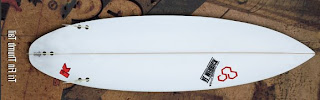
Rounded Squash - nice pivot and snap of squash tail

Squash Tail

Conditions - "knee to over-head" - ambrose
Very responsive, the squash surfboard tail design provides all the surface and planing area of a round tail, contributing to speed and lift and helping to maintain speed in slower spots. The rounded corners provide a bit more bite and control than the round tail, and the square end allows the board to release. The corners allow for more pivotal, abrupt turns off the bottom or on the face, but will provide less release off the top. This tail design relies on the tri-fin setup to maintain control. The squash is the most popular tail for a shortboard. One of the most versatile shapes. According to Proctor, more pivoty and snappy. Ambrose writes - "The squash is the child of the square. The edges of the once sharp square tail are simply rounded a bit to create a 'squashed' appearance. This tail results in a design that is more stable than the square yet still loose when it needs to be. The squash is by far the most popular and versatile tail today and is an excellent choice for beginners and experienced surfers alike."

Square Tail
Conditions - knee to overheard
The square tail is like the squash, but the pointed corners create more square turns with less release and more bite. According to ambrose surfboard shaper, this board is better in knee to overhead conditions. Ambrose continues - "This is a good overall tail shape although it is not a very common choice these days. The sharp corners provide a bite that aids in both drive and maneuverability. This is a tail that is loose and effective for smaller waves and more radical, fins-free surfing."

Swallow Tail

The swallow tail is related to the squash tail in that it provides more surface area from rail to rail, allowing for planing speed and lift. The tail of the board curves down to two points as in a squash, but the area between those points is decreased by a vee cutout resulting in two soft points. The decreased area between the corners and more pronounced points give the board more "bite" and control in critical maneuvers, as well as when going into and out of turns. The two points on the swallow tail act sort of like dual miniature round point tails, but without the pronounced "tracking" that a pin or rounded pin provides. The swallow tail is generally good for small waves, but it also is good for surfers who want a board that's going to stick during deep carves. Fish type surfboards tend to have a pronounced swallowtail, compensating for the wider, straighter outline which is more difficult to maneuver. According to Proctor, it creates something more loose and skaty.

Bat Tail
(sometimes called a star tail) This is rare surfboard tail design. It's a version of the swallow tail and essentially performs the same way. Helps keep the tail wider so the rails can run straigher down the length of the board. The bat tail is essentially just a cosmetic difference, as it is extremely difficult to percieve any difference between the Bat, Diamond and Swallow. Some say that the center point of the bat tail adds a bit more stability.

Diamond Tail
- The diamond tail is a lesser used tail design now that the squash tail has become more popular. The original intent of the diamond tail was to soften up the square tail but keep some of its speed.

Wing Tail:
The wing is really not a tail shape but more of a rail shape. It can be seen as the bump in the rails just in front of the front fins. Don't be confused and think that this is a different tail shape. The tail shown on the left is still a Swallowtail, the board also has a wing.


http://www.transworldsurf.com/surf/print/0,20087,1211781,00.html

osted 07.10.2006, By Casey Koteen - "What do the last few inches of your board actually do?"


It's common knowledge that a pintail is typical of a big-wave board and 95 percent of 6'2" shortboards are squashtails.
For shortboards, the squashtail is the undisputed king of tails. But why?

Is there really a huge difference between getting a rounded pin, squash, swallow, or something else on your shortboard, and could the average surfer even tell the difference?

"I think so," says master shaper Rusty Preisendorfer. "You start splitting hairs when you're talking about a rounded squash versus a squash, but I like to tell people that basically an angular tail creates a more angular turn."


It makes sense when you visualize how water flows off the back of a board as it goes through a turn. "Water is kind of a sticky substance," says Todd Proctor of Proctor Surfboards. "It's touching your board at the entry point, grabbing the rails, and the last thing it does before leaving the board is bending around the tail shape. It can bend around the tail and hold on to it the whole way, like on a rounded pin, which keeps things stable. The smoother the rail line is, as on a pin or rounded pin, the smoother the turn will tend to be.

On a squash, square, or any tail where you have some flat area, water jumps off the flat areas. That creates a pivot point and makes the board skatier."

Rounded tail (are smoother)


Square tails or wider tail shape (overall, more lift and release).

  1. Creates more volume. This translates to more
    1. Stability
    2. Lift,
      1. Both stability and lift are good for mushy sections, but they fair well in hollow surf, too. In a word, they're versatile."The water wraps around enough so it can carve," says Proctor, "but with the flat space at the end of the tail, the water can release and you can make the board pop off the lip. You've got the best of both worlds; it'll draw a nice, clean arcing turn, but it'll still release."

What about the wily and weird swallowtail? "Depending on the depth of the cut, you'll get a bitier tail. Swallowtails sink and bite a little better," explains Rusty.

That, too, makes sense, especially when you consider that most fish-type shapes have swallowtails. The thinking is that you want to have as loose a tail as possible on a fish, because their typically straight outlines make them quick down the line but harder to turn, and a bitier tail shape compensates for that.

If you're still having trouble processing some of the subtleties of tail design, Rusty describes it this way: "Just imagine you have three squashtails that are all the same: What happens if you cut a notch out of the tail and turn it into a swallow? Well, you lose area and volume, and that corner goes into the water and it becomes bitier. What happens if you sanded the corners off a squash? You lose some area, but you gain curve so the tail sinks a little easier and the board will be smoother feeling." Apply that thinking to the rest of your questions about tail shapes, and you start to get an idea about the cause-and-effect relationship each design has.

But ultimately, you have to actually ride each one of these different tails to really know how they differ. So get out there and start filling out an order form and experiment a little. You can stay conservative and order that swallowtail or rounded pin you've always thought about, or just go hog wild and order up some crazy asymmetrical tail-either way, you'll end up knowing more about surfboards.

Pull Quote: "I like to tell people that basically an angular tail creates a more angular turn."-Rusty Preisendorfer


http://www.proctor-board-shop.com/ProductDetails.asp?ProductCode=grovIV%2Ep%5F6963

Product Specs:
Dimensions: 6'3" x 18 5/8" x 2 1/4"
Tail Shape: squash tail
Construction: polyester/ Y2k UV Isothalic Light Cure Resin
Glassing: 4oz bottom, 4oz+4oz deck/ Direct Size cloth
Fins: FCS Fins

Rider Weight: 160 - 185 lb. / 72 - 84 kg


Groveler IV.p [performance]
Most versatile and well received new shortboard design.

This is a very fast design that generates it’s own speed when it’s small, yet holds in and rails tight arcs in the pocket when it’s overhead.

The rocker has a flatter area between the feet combined with an even, flowing single-to-inset double concave bottom. This creates a rail line that runs straighter from under the front foot to the lead-in fins, giving the board quick bursts of speed and incredible drive around sections. There is a good amount of tail rocker and release coming off the back fin allowing for lightening quick, explosive turns.


http://www.proctor-board-shop.com/ProductDetails.asp?ProductCode=sr71%5F6%2E2


Recommended Cure Time: cured & ready to ride
Construction: Polyester/ Y2k UV Isothalic Light Cure Resin
Glassing: 4oz & 4oz + 4oz Direct Size cloth
Fins: Future Fins
Rider Weight: 155 - 170 lb. / 70 - 80 kg

Blackbird
New and improved...

Straighter tail rocker increases drive
Heavier concaves through the fins adds a whole new responsiveness

Heavy single concave through the tail makes this board really alive in the pocket.

STILL....AND NOW MORE THAN EVER...A spry, lively bugger of a backfoot board. Developed around San Clemente’s variety of waves; goes mental in points, reefs, and beachbreaks alike.

It will release out the back and re-engage for fins-free type of maneuvers, airs and reverses.


Ideal Conditions: Knee-high to Slightly Overhead
Experience: Intermediate to Advanced
Designed for: Fins-free maneuvers, airs & reverses

Saturday, May 3, 2008

Fin terms

Base: refers to the length of the fin that touches the surfboard. The base influences the drive and acceleration of the fin.

Depth: is the length of the fin. The length of the fin influences a board's hold in the water. The longer the fin, the less slide or more stable the board. However, the problem is if the fins are too long, they can bog you down. A big fin will be 4 3/4 inches or 12 cms approx. A small fin will be 4 1/4 inches or 10.5 cms approx.

Area: because fins are not just two dimensional, a fin's area is more than base times height divided by two. There is also the thickness or its girth.

Cant: is the angle of the fin in relation to the board's side. A steep cant, means its leans closer to the rail.

Sweep:
The sweep of the fin is how far it is canted backwards. The further your fins are swept backwards the longer or more rounded your turns are going to be. A straighter fin will tend to pivot more.

Toe: The toe angle is the angle of the fin in relation to the stringer. A 0° toe angle means the fin is parallel to the board. Unfortunately, box plugs are impossible to move as they are determined beforehand by the shaper.

Foil: Fins are similar to the wings of airplanes since both are foiled (curved). Centre or back fins are typically foiled on both sides and side fins are most often foiled on the outside, but flat on the inside.This creates high pressure and low pressure. Hence it is designed to move into the wave (hydrodynamics) to hold you in (move away from high pressure to low pressure).
Just like the weather where wind flows from high to a low.

Flex: Weight is important as is flex. The lighter the better.

Futures

Although selecting a fin seems like an incredibly simple issue, it is not. In actuality, the nuances between set are small, making the decision difficult. The intention of this page is to clarify the misconceptions and help you select the right fin.

First, the most important issue is your weight. For your ease, Futures recommends selecting your fin based on the riders they provide.

So, the main riders are as follows:
  1. Pancho Sullivan (160-200+)
  2. Mikala Jones (130-170)
  3. John John (lighter than Mikala Jones


For me, however, and I am sure others, this assistance guide is difficult. For me, I weight 170. Therefore, do I want to be on the upper limit of Mikala Jones or on the lower end of Pancho Sullivan.

Next, the question is what material. Below, each material is laid out with a brief description beside each:
  • Black Stix CTM - engineered flex; torsional flex created by cresent shaped carbon along the leading edge. The inlay of two materials creates this unique torsional flex pattern storing potential energy when flexed, which is released during turns.
  • Fiber composite - Good Starting point. Sensitive, snappy and a lightweight fin that retains proper flex patterns for performance.
  • Natural composite - Great flex rebound characteristics, an all around material.
  • Fiber Glass - Sensitive fin with a natural, progressive flex pattern. Heaviest of all construction
  • RTM - Resin Transfer Molded - Advanced aerospace technology, customized flex patterns, unique ride, light foam core and hex, fast, light, loose.
  • Glass lite RTM - Foam core, very light, bold colors. Natural, flex pattern of glass
  • Red Black Tip-Soft Flex RTM - Foam core. For lighter riders, smaller surf or looser ride, very light.
  • Clear Hex Glass RTM - Natural progressive flex patterns, this is basically a removable glass on fin.
  • Blue Aluminum RTM - Aluminum coated foam core - Special flex pattern for Vector 1. Lightest fin on market.
  • CTM - Comibned Transfer Molded - Engineered Flex created by a unique process to create and control flex
Personally, my favorite material is the Black Stix. Also, given that they are the newest, I assume the have the best technology and therefore performance.


Best to start with rider weight- Number on each Future fin denotes height of fin in inches. Larger the number, the bigger the fin. For example: FG1-400= G1 template at 4 inches high. EA- 450= EA template 4.5 inches high. Currently using Vector Tech Foils (VF 460) - Vector Tech Foils VF 460.

Weight in lbs

**Generalization ** -

  1. more height means faster,
  2. less base means looser
  3. less area means looser
  • 130 lbs / 59 kgs. and below -
  • 130-160 lbs -
  • 160-190 lbs
    • No - height too small and not enough area
      • FWCT-450
        • Height: 4.5 in – 11.4 cm; Base: 4.37 in – 11.1 cm*; Area: 14.89 in² – 96.06 c
        • The name says it all. For progressive and high performance surfing.
        • Available Materials: Fiber glass
    • No - not a lighter rider (based off of this, looking for something with base bigger than 4.45 and area greater than 96.19 cm).
      • FYU- 4.59
        • Side Fins: Height: 4.59 in – 117 cm; Base: 4.45 in – 11.3 cm*; Area:* 14.91 in² – 96.19 cm²;
        • Center fin: Height: 4.44 in – 11.3 cm; Base: 4.25 in – 10.8 cm*; Area:* 13.3 in² – 85.81 cm²
        • A high performance fin for the fast lighter rider. Lots of drive and easy release off the top.
        • Available Materials:- RTM Soft Flex, Fiber Glass (all 4 colors), RTM Honecomb (ClearHex), RTM GlassLites
    • No - this fins appears also for 130-160 lbs surfers, too small
      • FJC1-460
        • Height: 4.58 in – 11.6 cm; Base: 4.37 in – 11.1 cm*; Area:* 15.05 in² – 97.1 cm²
        • This fin equals drive. The full tip with a medium base allows this fin to do its magic.
        • Available Materials: CTM Black Stix; Natural Composite
    • No
      • FMB1
        • HEIGHT 4.62 in - 11.7 cm; BASE 4.5 in - 11.5 cm*; AREA* 14.84 in² - 95.74 cm²
        • This template was designed for speed, perfect for fast surfers with a loose style!
        • Available Materials: Clear Hex
    • No - appears too small, not a loose style
      • FAM1-450
        • VII FAM1*- Height:* 4.563 in – 11.6 cmBase: 4.50 in – 114 cm Area: 14.84 in² – 95.74 cm²
        • One of our most popular templates along with the VII Foil generates speed while releasing off the top.
        • Available materials - CTM Black Stix, Natural Composite
    • No
      • FWT-453
        • Height: 4.53 in - 11.5 cm; Base: 4.49 in - 11.4 cm; Area: 15.1 in² - 97.42 cm²
        • Tested and proven in Hawaii. For serious power surfing.
        • Available Materials: -Fiber Glass (blue, red, smoke, clear).
    • No - want a base bigger than 4.45, this is too loose
      • FDHD-469
        • Height: 4.69 in - 11.9 cm; Base: 4.33 in - 11 cm*; Area:* 15.19 in² - 98 cm²
        • With a taller height, smaller base, and less area; this fin is fast and loose.
        • Available Materials: Fiber Composite (Black/White)
    • FJS-466
      • Height: 4.59 in - 11.7 cm; Base: 4.35 in - 11 cm*; Area:* 15.13 in² - 97.61 cm
      • A fast and loose template accompanied by a Vector Foil allows this fin to make sections and destroy them.
      • Available Materials: RTM Honeycomb
    • FEA-450
      • Height: 4.57 in – 11.6 cm; Base: 4.40 in – 11.2 cm*; Area: *15.16 in² – 97.81 cm
      • The EA template accompanied by a VII Foil is perfect for in the pocket surfing. Perfect for medium size waves and powerful surfers.
      • Available Materials: CTM Black Stix; Natural Composite; GraphFlex - Blue Camo NEW!
    • FGP-456
      • Side fins: Height: 4.56" – 11.61 cm; Base: 4.40 in – 11.2 cm*; Area:* 15.2 in² – 98.06 cm²
      • Center Fin: Height: 4.375 in – 11.1 cm; Base: 4.25 in – 10.8 cm*; Area:* 14.2 in² – 91.61 cm²
      • Tested and proven for years in Hawaiian waters.
      • Available Materials:Fiber Composite (Black/White)
    • FR1-454
      • Height: 4.54 in – 11.5 cm; Base: 4.27 in – 10.8 cm*; Area: *15.21 in² – 98.13 cm²
      • This template is specifically designed for explosive radical surfing. Perfected by the Pros, the VII FR1 is great for speed and releasing off the top.
      • Available Materials: CTM Black Stix; Natural Composite; GraphFlex - Grey Camo NEW!
    • FTP1-4.62
      • Height: 4.62 in – 11.7 cm; Base: 4.52 in – 11.5 cm*; Area:* 15.27 in² – 98.52 cm²
      • Its wide base with a narrower tip makes this fin a standard for high performance surfing.
      • Available Materials: Fiber Composite (black/white); Fiber Glass (all 4 colors); *NEW RTM Honeycomb (blue, red, yellow, green)
    • Maybe
      • VF3/2/1-452
        • Height: 4.52 in – 11.5 cm; Base: 4.37 in - 11.1 cm*; Area:* 15.39 in² - 99.29 cm²
        • Trailer: FCH2 (450 Hatchet); Height: 4.50 in - 11.4 cm; B*ase:* 3.35 in - 8.5 cm; Area: 13.2 in² - 85.16 cm
        • The revolutionary VF452 3/2/1 cuts down drag by increasing water attachment, which allows for maximum speed. Ideal for fast punchy beach break, vertical surfing, and powerful waves. 3 foils, 3 different angles of attack give incredible drive through the turns, with a tip that allows immediate release.
        • Available Materials: Natural Composite
    • No - appears a touch too big
      • FChilli-474
        • Height: 4.74 in - 12 cm; Base: 4.54 in - 11.5 cm; Area: 15.65 in² - 100.91 cm²
        • Great for all conditions, from height and base to area, it is a well balanced fin.
        • Available Materials: Fiber Composite (Black/White)
    • No
      • F5-450
        • Height: 4.50 in – 11.4 cm; Base: 4.45 in – 11.3 cm*; Area:* 15.89 in² – 102.52 cm²
        • This is a looser template than the F6, but is also for bigger guys or bigger waves.
        • Available Materials:Fiber Composite Black/White.
    • No
      • F6-461
        • Height: 4.54 in – 11.51 cm; Base: 4.57 in – 11.6 cm*; Area:* 15.71 in² – 101.35 cm²
        • Classic down the line fin for the bigger guy or bigger waves, works on everything: shortboards, guns & funboards.
        • Available Materials: Fiber Composite Black/White.
    • No
      • FR3-450
        • Side fins: Height: 4.53 in – 11.5 cm; Base: 4.70 in – 11.9 cm*; Area:* 16.13 in² – 104.06 cm²
        • Center fins: Height: 4.48 in – 11.4 cm; Base: 4.48 in – 11.4 cm*; Area:* 14.6 in² – 93.9 cm²
        • Speed and Drive...A larger base fin with a lot of area, holds great for heavier surfers and powerful waves.
        • Available Materials: Natural Composite; NEW! GraphFlex - natural checkers
    • No
    • No
      • VF3/2-467
        • Height: 4.67 in – 11.9 cm*; Base:* 4.64 in – 11.8 cm; Area: 16.47 in² – 106.26 cm²
        • Trailer: FCH1 (425 Hatchet); Height: 4.25 in - 10.8 cm; Base: 2.56 in - 6.5 cm; Area: 11.55 in² - 74.52 cm²
        • The VF467 3/2 decreases drag while increasing speed. Perfect for point breaks, power surfing, and powerful waves.
        • Available Materials: Natural Composite
    • FPS-476

FOIL - similar to the rocker and bottom shape of surfboards. IE double barrel concave or single concave. Foil powerband - water attachment and release - foils are designed to release at different points in a turn. Flat fins release earl to control speed and have a narrow powerband. The Vectors and Scimitar are designed t o hold onto water (attachment) and in turn create more speed, longer throughout the turn - best for conditions when you need to generate speek and larger waves when you need to blast around sections.

  • Sounds very nice
    • Vector 1- Fast tight top turns, good round house turns, carries speed from maneuver to maneuver
    • Vector 2 - Vector Foil at base transitioning into a flat foil towards the tip. Creates burst of speed off the bottom, yet feels loose and free on the top turns and great for breaking out the tail.
    • Vector 321 - Projects out of every move. Great for punchy beach breaks, designed for tight and crisp top to bottom surfing.
      • Triple Plane angles
    • Scimitar
      • the Scimitar is a constant varible plane fin, based on a variable algorithm. Starting with our Vector foil, the fin twists from the base of the fin and then cants in. We do it on three different agles of attack for maximum water attachment. A highly refined design and smooth riding fin that holds through more of the turn. A very lively fin, best for rail-to-rail surfing.
  • Maybe
    • Classic flat side - First foil used for thruster setup. Conventional feel for pocket surfing.
  • No - seems like a bad call
    • Vector 3.2 - Good for powerful waves. Makes long sections by holding speed down the line. Very loose off the top. Good for long lined up waves.


  • Vector
    • VF 460
      • Power, Speed, Drive...For power surfing, larger surfers, and bigger waves.

How to choose an OUTLINE
Similar to choosing outline of surfboard and dimensions of surfboard, this is just like choosing the correct fin template.